A panel discussion focusing on biotechnology in Kenya was held during the commemoration of this year’s African Scientific Revival day. ‘Has Biotechnology worked for Kenya?’ – this was the title of the session whose panel consisted of Dr. Francis Nang’ayo, manager regulatory affairs at African Agricultural Technology foundation (AATF-Africa); Dr. Susan Musembi, an animal biotechnologist from Kenyatta University who is also director of STEM Africa and the scientific advisor at the Chandaria Information Centre at Kenyatta University; Dr. Roy Mugira a molecular biologist and government advisor on biotechnology policy- Ministry of Education, Science and Technology; Mr. Kevin Oyale from African Biotechnology Stakeholders Forum (ABSF) who is the coordinator of Kenya Youth Biotechnology Network (KYBNet); Mrs. Purity Nyaga, the head of sciences in Hospital Hill High School and head of biology; and Mrs. Beatrice Mwaura, a member of the Saba Saba agribusiness cooperative society and a banana breeder from Muranga county.
Noting that Kenya operates in a global space, Dr. Nanga’yo expresses that it was paramount that the global environment be considered in such discussions, and added that he would ask the question differently; ‘Has Biotechnology worked for the whole world?’
In her response, Dr. Musembi took the growth of the knowledge economy approach to answer this question where she explained that this is what drives the development of a nation. Universities form the key place where that knowledge can be generated. Apart from national and international institutions, almost all universities in Kenya are currently running programmes that revolve around biotechnology. Dr. Musembi informed the audience that research competences have grown with three universities in Kenya as well as public research institutes currently having basic functional equipment and as a spin off from biotechnology. “we have seen entrepreneurship and creation of biotech companies” she asserted, highlighting the following:
- Kenyatta University has a plant transformation lab and green houses.
- University of Nairobi boasts of Center for Biotechnology and Bio-informatics.
- the Kenya Medical Research Institute (KEMRI) has a production unit for rapid diagnostic kit and reagents production.
- Moi University has a programme for generating reagents for the hospital like buffers
During the panel discussion, it emerged that to facilitate and encourage innovation and entrepreneurial activities at the university, Kenyatta University has spearheaded the Chandaria Business and Incubation Centre where they encourage staff and students to come up with ideas that can be commercialized. The centre helps these students understand intellectual property (IP), and if their ideas are patentable or not. Currently, they have nothing in biotechnology , a situation that begs many questions: can innovation be taught? could it be that our education system does not allow our students to be innovative or are we engaging students the wrong way? Unlike in other fields, Dr. Musembi acknowledged that they recognize that in biotechnology, incubatees need rich environments where they can interact with the lecturers and the professors as well as industry to grow the ideas to competitive levels.
To summarize on innovation in biotechnology by universities, Dr. Musembi showed that universities around the world have been doing great rolling out patents and business inventions in hundreds. University of Massachusetts for example, is the bedrock of most biotech companies. As much as biotechnology is a high-risk investment area, we can as well grow our universities and encourage innovation and entrepreneurship.
Stating that the youth may not be willing to go to the farms but are involved from the enterprising point of the industry, Mr. Oyale seemed to concur with Dr. Musembi and emphasized that the youth are also part of knowledge production, doing research in the universities.
The discussion extended into policies in the country and how these affect biotechnology development, specifically the ban on GMO. Dr. Nang’ayo advised that it is essential to involve the government in such meetings because it is the policy holder. He emphasized that for subsequent meetings, an entry point to the government at the higher levels either at institution or cabinet secretary to principal secretary of science and biotechnology should be established. this he said will make more impact if the highest level of decision making is engaged in these discussions.
In conclusion, Mrs. Nyaga challenged the audience by posing several questions. What next after embracing biotechnology? What do we do with the products and trained biotechnologists? What does the government offer youth who have the knowledge? She articulated that unless these issues are addressed, it may not be possible to get youth into sciences and retain them.
The Open Forum on Agricultural Biotechnology (OFAB) is a platform that brings together stakeholders in biotechnology, to enable interactions between scientists, journalists, the civil society, industrialists, lawmakers and policy makers. OFAB holds monthly lunch meetings that provide an opportunity for key stakeholders to know one another, share knowledge and experiences, and explore new avenues of bringing the benefits of biotechnology to the African agricultural sector.
The May 2014 session held at The Nairobi Safari Club Hotel was aimed at emphasizing on the need for the government to lift the ban imposed on the importation of Genetically Modified products with a special feature on Bt Cotton. It was attended by more than 200 participants ranging from politicians, industrialists, farmers, scientists, students and journalists to general public. Among the presenters included H.E. Jack Ranguma, the Governor, Kisumu County and Chairman, Governors Council’s Committee on Health and Biotechnology; Dr. Moses Rugut- Ag. CEO, National Commission on Science, Technology and Innovation (NACOSTI); Prof. Dorington Ogoyi- Director, Technical Services National Biosafety Authority (NBA); Dr. Charles Waturu, Centre Director Kenyan Agricultural Research Institute (KARI) Thika; Dr. Margaret Karembu, Director International Service for Acquisition of Agri-biotech Applications (ISAAA) AfriCentre and Dr. Jonathan Irungu Waithaka- Director, Crop Management, Ministry of Agriculture. Calvince Onyango from The Scinnovent Centre was one of the participants during the May 2014 meeting.
The context
On November 12th 2012, the then Minister for Public Health in Kenya placed a ban on the importation of genetically modified products based on a publication study by Professor Seralini in one of the science journals. The report, which has since been disproved by the global scientific community and the French Academy of Sciences as lacking in scientific procedures, claimed consumption of GMOs could cause cancer. Following the ban, a task force was commissioned to look investigate and produce a report. Several discussions have been held among the stakeholders on the ban. Citing a drop in the number of cotton ginneries in the country following inadequate supply of cotton, Ranguma stressed on the importance of lifting the ban. He highlighted that the key reason why Africa Growth and Opportunity Act (AGOA) as formed by the former U. S President George Bush is to help African countries by giving their textile products preferential treatment in U. S and other European Markets. Unfortunately, these benefits are not being enjoyed by Africans and particularly Kenyans since we lack enough cotton to make our clothing, shunning away investors from the trade. This can be solved by adopting new and most current technologies such as Bt Cotton.
Biotech crops contribute to food security and sustainability by increasing production and providing a better environment as the use of pesticides is minimal. The National Biosafety Authority (NBA) was established to regulate research and commercial activities involving genetically modified organisms (GMOs) with a view to ensure safety of human and animal health and provision of an adequate level of protection of the environment. The authority has since established a transparent science-based and predictable process to guide decision making on applications for approval of research and commercial activities involving GMOs. However, the authority is yet to receive an application for commercialization of Bt Cotton from the developers in order for them to start the approval process. For Kenya to commercialize Bt Cotton, it needs a positive political will and support from development partners, well structured regulatory bodies which are already in place as a result of the National Biosafety Authority Act, 2009, and sharing of information on GM technology by the scientists and stakeholders. It is necessary to offer solutions to the food security problems in Kenya and convey unbiased information to the public on the importance of the adoption of GM technology to maximize food production and agricultural development.
To The Scinnovent Centre, the platform offered an opportunity to meet our focus on understanding the barriers to adoption and use of science, technology and innovation for decision making and wealth creation in the agricultural sector.
This article was written by Calvince Onyango, an intern at The Scinnovent Centre.
The 3rd Kenya National Science Technology and Innovation week held from 19th to 23rd May, 2014 focused on the theme “Science, Technology and Innovation as a catalyst for Industrial Growth in Kenya.” This was befitting considering that Kenya’s development blueprint – The Kenya Vision 2030 – envisages a phenomenal transformation of Kenya into a newly industrialized middle income country that will offer better quality life to all its citizens. One of the ways to achieve this is through supporting and encouraging innovations that will improve lives, create jobs and fast-track our economic growth. In the past, Kenyan researchers have conducted numerous interesting and ground-breaking studies but unfortunately, the findings have rarely been translated to products of commercial or social value. Unarguably, it is time to shift from a paradigm that emphasizes research (whose outputs may never be used) to one that emphasizes the application of knowledge, whether generated through research or experience i.e. innovation
In a joint presentation, Dr. Maurice Bolo (Director The Scinnovent Centre) and Dr. Ellie Osir (Senior Programme Specialist IDRC) emphasized the need to shift the thinking in our universities from research to innovation. In their presentation, knowledge was singled out as the new motor in economic development in the emerging knowledge societies.
They further acknowledged that the context for science, technology and innovation (STI) is fast-changing from the traditional policy of just being concerned with creation of new knowledge to emphasizing more on application and exploitation of knowledge for economic and social development. Consequently, STI needs both methodological and organizational change to appropriately respond to the changing context. This shift calls for participatory problem identification and priority setting as well as flexible learning organizations as opposed to the bureaucratic organizations we have had in the past.
In light of this shift, it is prudent and highly imperative to have a labor force with extreme expertise to promote STI for development. Hence, the NACOSTI/IDRC University Research Chairs Programme. This programme is focused on enhancing Kenya’s competitiveness in innovation by ensuring the Research Chairs will:
- Improve the institutional environment in our universities towards attaining research excellence and fostering creativity, innovation and entrepreneurship
- Improve the research infrastructure through investment in laboratory equipment and machines
- Provide skilled and highly trained manpower into the labor market through postgraduate training
- Leverage financial support to research from private sector and other financial institutions to support university research and training
- Create active linkages with private sector to ensure that knowledge created in the universities respond to the needs of the productive sectors
In reference to the book ‘Re-thinking Science’ the speakers emphasized the need to re-think our approaches to STI by shifting from linear to systemic science in order to achieve industrial transformation in Kenya.
You can download the presentation here
This post was contributed by Vivian Otieno from The Scinnovent Centre.
As countries transition into the knowledge-based economy, the role of knowledge is becoming ever more imperative. Consequently, its generation, sharing, application and translation into economic or social use has become a key determinant in the competitiveness of firms, organizations and nations. Policymakers and development practitioners are now paying a keen attention into the processes of knowledge production and their linkages with the productive sectors.
In Africa, numerous studies have shown however, that there exist minimal linkages between the public sector research organizations , and the knowledge users (mainly the private sector). This weak linkage undermines the ability of the public sector research to create insights of direct relevance to society through engagement with communities in which they are located.
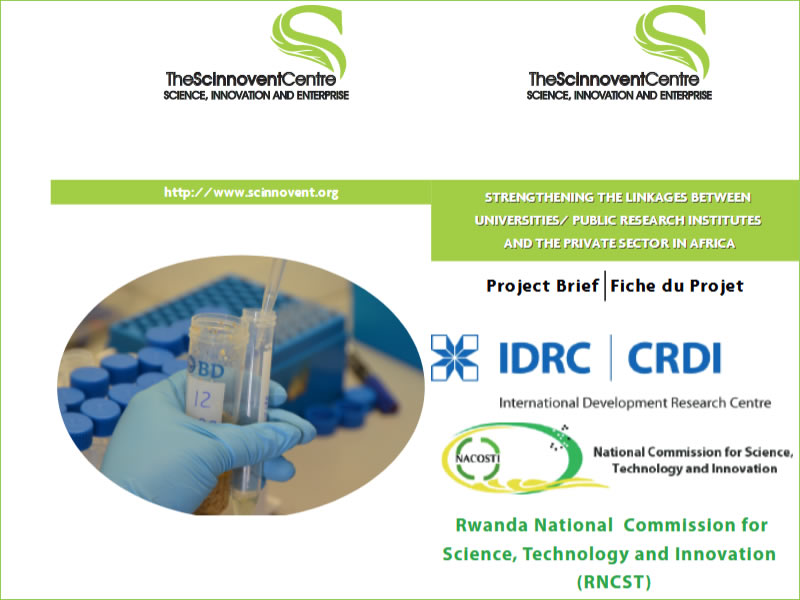
A new study by The Scinnovent Centre with support from the International Development Research Centre (IDRC) seeks to explore the factors that enable or constrain the translation of public sector research outputs into commercial products, and share lessons and best practices that can be adapted and adopted within African contexts. This study will interrogate the impediments facing commercialization structures (competencies and skills); the role of governance (institutional policies, habits, culture, practices and power relations) as well as the role of intellectual property rights regimes on the appropriateness of public sector research.
By comparing cases from Kenya and Rwanda, the study will elucidate the important role of policy, institutional and governance contexts on the uptake of research outputs. In the overall, the study seeks to provide a framework that can be adapted by the universities/public research institutes in developing strategies and action plans to enhance uptake of research outputs and strengthen their linkages with the private sector. More specifically, the information generated will provide research managers with a better understanding of the challenges facing commercialization structures; researchers will be better appraised on the various International Property (IP) appropriation strategies and which IP forms better meets the needs of the private sector and finally, policymakers will have a better understanding of the influence of the country’s IP laws on innovation, commercialization and competitiveness.
The study will be carried out in partnership with the National Commission for Science, Technology and Innovation (NACOSTI) in Kenya, and the Rwanda Commission for Science Technology and Innovation.
Download the project brochure here